
Developer Loan 2026: Guide to Financing Your Real Estate Development

The developer loan is the financial instrument that decides whether a real estate development is genuinely profitable or merely possible. In a Spanish market where urban land is scarce and construction costs keep pressuring margins, getting the financing structure right in 2026 is worth as much as getting the location right.
This guide covers what a developer loan is, how it works step by step, the real 2026 market conditions, the documents you will be asked for, how it compares to a bridge loan and a self-build mortgage, and a simulator so you can project the numbers for your own project. Whether you are starting your first development or you are an experienced developer exploring alternatives to traditional banking, this is the complete framework.
*The financial conditions detailed in this post are purely indicative and vary depending on the financial institution, the client's profile, the specific characteristics of the financing, and market conditions at the time of application. The information provided does not constitute a binding offer or a guarantee of obtaining financing.
Table of contents
- What is a developer loan?
- How does a developer loan work? (step by step)
- Conditions and requirements for a developer loan
- Documents required to apply for a developer loan
- Types of developer loan: banking vs. alternative
- Developer loan vs. bridge loan vs. self-build mortgage
- Developer loan simulator
- Real-world example: financing a real estate development
- Frequently asked questions
- Conclusion
What is a developer loan?
A developer loan is specialist financing for builders and property developers that covers land acquisition and the construction of a development, with progressive drawdowns linked to construction progress. It is also called developer credit, real estate developer loan or property developer financing, and in practice all of these labels describe the same product.
Compared with a conventional mortgage, the developer loan has three structural differences:
- Borrower: a mortgage finances the end buyer of a completed home; a developer loan finances the developer during construction.
- Term: 18-48 months for the developer loan vs. 20-30 years for a mortgage.
- Drawdown: the developer loan is released in tranches against construction certifications; a mortgage is disbursed in full at signing.
If you are evaluating whether this instrument fits your project, we also recommend reading whether the developer loan is the right option for your real estate project.
How does a developer loan work? (step by step)
A developer loan follows a clear cycle, from project submission to final redemption after unit sales. Here are the seven real steps:
-
Application and project submission. The developer submits the full dossier: technical and financial feasibility study, building licence (or its procedural status), approved architectural plans, detailed budget, sales programme, and corporate documentation.
-
Project analysis by the lender. The lender evaluates three things in parallel: the project's economic viability (margins, expected sales price, market absorption), the developer's financial standing, and the quality of the collateral (land + future construction).
-
Appraisal. An approved valuer issues a report on the current value of the land and the prospective mortgage value of the built-out development. This report is the basis for the LTV the lender will be prepared to offer.
-
Approval and formalisation. With a positive opinion the final terms are set (interest rate, APR, fees, tenor, grace period, LTV) and the agreement is signed before a notary. The deed includes the mortgage over the land and the future construction.
-
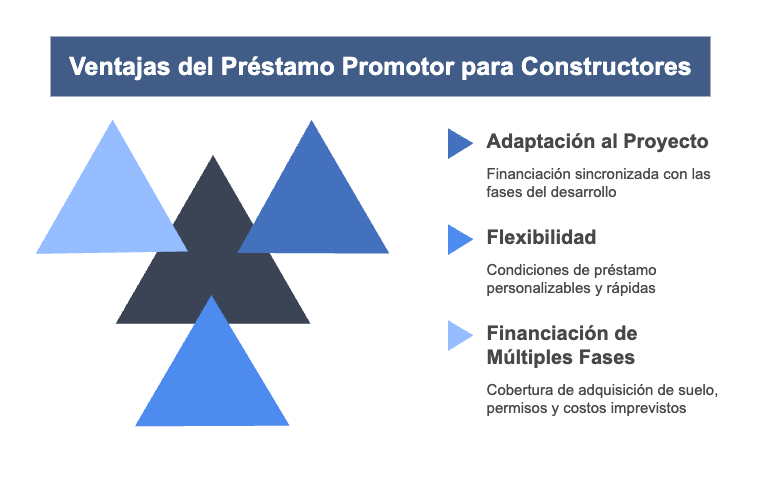
Progressive drawdowns against certification. The capital is not released in one go. It is drawn in tranches — typically between 4 and 8 drawdowns — each backed by a certification issued by the project management team confirming the percentage of work completed.
-
Construction completion and first occupancy licence. On completion, the Certificate of Final Works and the First Occupancy Licence are issued. At this point the final tranche of the loan is released (typically 5-10% of the total).
-
Subrogation and redemption. Buyers sign their individual mortgages and subrogate the proportional share of the developer loan that corresponds to their unit. The non-subrogated portion is repaid in cash from the sale proceeds. When the last unit is sold, the loan is extinguished.
A critical detail for project cash flow: during construction there is usually a principal grace period, so the developer only pays interest on the capital actually drawn down. In many structures the interest itself is capitalised and settled at the end, paid out of sales proceeds.
Conditions and requirements for a developer loan
Conditions vary considerably depending on the funding source (bank or alternative capital), location and developer profile. These are the ranges we are seeing in the Spanish market in 2026.
LTV and Loan-to-Cost
- Traditional banks: 50-60% over total project cost (land + construction). Land only: 50-55%.
- Private capital and specialist funds: 65-70%, peaking at 75% with consolidated pre-sales (30%+) or additional guarantees.
The LTV is not a universal ceiling: what really matters is the quality of the project, the location and the developer's skin in the game. For context on LTV in land purchase financing, the ratio tends to be more conservative than in a combined land + construction deal.
Interest rates in 2026
- Traditional banks: nominal rates between 4.5% and 6.5%, APR between 5% and 7.5% — with 12M Euribor around 2.6-2.9%.
- Private capital: nominal rates between 8% and 14%, depending on tenor, LTV and project risk.
Banks deliver price; private capital delivers speed, flexibility and LTV. A project with solid margins and a short tenor absorbs the higher cost of private capital perfectly when the opportunity cost of not starting is greater.
Term and grace period
- Total tenor: 18-48 months. Construction 18-36, sales 6-12.
- Principal grace period: standard throughout construction, sometimes extendable 3-6 months after completion.
- Extension: usually up to 12 additional months, subject to a specific fee.
Collateral and use of funds
The principal collateral is the mortgage over the land and the future construction. Private capital occasionally requires personal guarantees or pledging of sales proceeds. Funds can be used for:
- Purchase of urban land (where applicable).
- Project costs, licences and fees (up to 8% of the budget).
- Construction works execution.
- Contingencies and justified budget overruns.
- In some cases, heritage rehabilitation or sustainability capex.
Documents required to apply for a developer loan
The quality of the application file is a large part of the outcome. This is the real checklist reviewed by credit analysts:
Corporate documentation
- Articles of association of the SPV/developer company.
- Powers of attorney of the legal representative.
- Tax registration (CIF) and model 036.
- Shareholder structure and board of directors.
- Annual accounts for the last 2-3 financial years (if the company has history).
Financial credibility
- Personal or corporate income tax returns for the last 2 years.
- Certificate of being current on tax and social security obligations.
- CIRBE report (Spanish credit registry) for the developer and guarantors.
Project documentation (the most decisive)
- Title deed or land purchase agreement with earnest-money deposit.
- Planning certificate and land classification.
- Building licence — at least in advanced procedure, ideally granted.
- Basic and execution plans visaed by the College of Architects.
- Feasibility study — IRR, NPV, project cash flow.
- Detailed budget broken down by line item, with measurements.
- Construction programme (Gantt) and sales programme.
- Market study: comparables, €/m² prices and absorption velocity.
- Signed pre-sales or reservation contracts (if any).
Additional technical documentation
- Geotechnical and topographical report.
- Health and safety study.
- Energy efficiency certificate for the project.
A complete, well-ordered application file compresses approval by 3 to 6 weeks. At GrupInversor we help developers structure the dossier before submitting it — it is the difference between a "yes" and a "come back when you have X."
Types of developer loan: banking vs. alternative
Not every developer loan comes from a bank. The Spanish market in 2026 has two broad families of lenders, with very different logics.
| Criterion | Traditional banking | Private capital / funds |
|---|---|---|
| LTV / Loan-to-Cost | 50-60% | 65-75% |
| Indicative nominal rate | 4.5-6.5% | 8-14% |
| Approval speed | 3-6 months | 3-6 weeks |
| Pre-sales required | 30-50% typically | Flexible, sometimes 0% |
| Underwriting | Developer track record + project | Project-based, viability leads |
| Flexibility on terms | Low, standardised committees | High, bespoke structures |
| Best fit for | Established developers with time | Deals with tight timing, opportunistic land, younger developers |
Alternative financing for real estate developers via private capital is not a patch for deals the banks turned down: it is a strategic tool when speed and LTV outweigh price. The best developers combine both sources depending on the phase.
Developer loan vs. bridge loan vs. self-build mortgage
Three products that are often confused but solve different problems:
| Feature | Developer loan | Bridge loan | Self-build mortgage |
|---|---|---|---|
| Borrower | Developer company | Developer or individual | Individual |
| Purpose | Finance land + construction of a development | Cover a temporary gap between two transactions | Self-build a home for personal use |
| Tenor | 18-48 months | 6-24 months | 20-30 years (final mortgage) |
| Drawdown | Tranches against certification | Single or two tranches | By certification during construction, fixed mortgage at completion |
| Typical LTV | 50-75% over total cost | 50-65% over asset value | 70-80% over final mortgage value |
| Redemption | Subrogation + sales | Final transaction or refinance | Amortisation over 20-30 years as a conventional mortgage |
| Typical unit | Multiple homes | 1 asset or portfolio | 1 home |
If the project is a development of multiple units for sale, the product is a developer loan. If you need to bridge a pending sale to buy the next plot, look at the bridge loan. If you are self-building your primary residence, the self-build mortgage is the natural route.
Developer loan simulator
Before sitting down with the lender, run the numbers in the simulator. You enter land cost, construction budget, target LTV and tenor, and the simulator returns the estimated instalment, the drawdown schedule and the total finance cost.
Want to see what developer loan would fit your project?
In under two minutes, using your project figures, you will get:
- Estimated instalment and drawdown schedule against construction certifications.
- Indicative maximum LTV across traditional banks and private capital.
- Total finance cost for the project and a comparable APR across scenarios.
Real-world example: financing a real estate development
A case that illustrates what is possible when traditional banking says "no" is a development we structured in Sitges (Barcelona) on a building with protected heritage elements. The project was the rehabilitation and conversion of a historic building into a high-end residential development.
Project context:
- Total project cost: ~€6M (land + works + heritage rehabilitation).
- Developer equity: 30%.
- Banking issue: the heritage rehabilitation component was treated as high risk because restoration timelines and costs are less predictable than new-build construction.
Structure we put together:
- €4.2M developer loan funded with specialist private capital.
- 70% LTV over total project cost.
- 30-month tenor (24 construction + 6 sales).
- Full principal grace period during works; capitalised interest.
- Redemption via subrogations on 85% of the loan.
Outcome: the developer started work 4 months earlier than would have been possible by continuing bank negotiations, and the extra finance cost (~200 bps over bank pricing) was more than offset by the time gained in a rising market. The development closed with >90% signed pre-sales before completion.
It is an example of when private capital is the right tool: singular projects, with components banks penalise, and where timing is strategic. GrupInversor has structured similar deals in Barcelona, Madrid, Valencia, Alicante and the Balearic Islands.
If your project sits in the construction and real estate development sector, understanding these options is essential to structuring financing well.
Frequently asked questions
What is the difference between a developer loan and a developer credit line?
In practice the terms are used interchangeably to describe the same product: specialist financing for builders and developers that covers both land and construction. Technically a loan is drawn down as a lump sum while a credit line is revolving, but in developer financing we almost always talk about progressive drawdowns against certifications, so the labels are effectively synonyms.
What is the maximum LTV on a developer loan in Spain?
Traditional banks typically cap the LTV at 50-60% of total project cost. Private capital and specialist funds regularly structure deals at 65-70%, and up to 75% with consolidated pre-sales (30%+) or additional guarantees. There is no universal ceiling: quality of the feasibility study and a prime location can shift the LTV by 10 percentage points.
Can an individual developer apply for a developer loan?
Yes, although most lenders require a special-purpose vehicle (SPV or Spanish SL) for tax, liability and traceability reasons. An individual developing their own primary residence can use a self-build mortgage, which is a different product. For the development and sale of multiple units, setting up the developer company first is standard.
What happens to the loan when the units are sold?
Once construction is complete, the developer loan is settled through subrogation: each buyer takes over the proportional share of the loan for their unit, converting it into a 20-30 year individual mortgage. The non-subrogated portion is repaid in cash from sale proceeds. This mechanism frees the developer from refinancing risk and transfers the debt to the end buyer at no additional cost.
How long does a developer loan take to be approved?
Traditional banks: 3-6 months end to end. Private capital: initial assessment in 24-48 hours and formal approval in 3-6 weeks when documentation is complete. The key variables are the quality of the feasibility study and having the building licence at least in advanced procedure.
What happens if the project is delayed?
Contracts typically include a contractual extension — up to 12 additional months — subject to a specific fee. If the delay compromises the sales programme, the drawdown schedule and grace period can be renegotiated. The worst response is waiting for alarms: early communication plus a contingency plan is the difference between an agreed extension and a default.
How much does a developer loan finance?
Up to 70-75% of total project cost (land + construction) in well-structured deals with alternative capital. The developer contributes the remaining 25-35% as equity. Banks in particular often also require a minimum level of pre-sales (typically 30-50%) before the first drawdown.
Conclusion
The developer loan is, more than a source of capital, the structure that defines the profitability of a development. The right tenor, the right LTV, drawdowns synchronised with the works and a well-planned subrogation all flow directly into the project's IRR.
In a 2026 with the cost of money stabilising but still demanding, the best-performing developers combine two sources: banks when the timeline allows it, and private capital when speed or LTV are the critical factor. The call is not banking versus alternative: it is using the right tool for each phase.
If you want to dig deeper into the service, see our developer loan page with conditions, terms and a built-in simulator. And if your deal falls into the bridge range (temporary gap between two transactions), see our bridge loan service.
Planning your next real estate development? Contact us today for a free initial assessment. Our team will respond within 24 hours with an evaluation of the financing options available for your specific situation.