Building Renovation Financing: Options and Requirements 2025


Introduction
Building renovation financing has become a cornerstone of Spain's efforts to modernise and revitalise its existing property stock. With energy efficiency and sustainability now firmly on the national agenda, identifying the right funding options is essential for property owners, residents' associations, and developers alike.
The options currently available range from property rehabilitation loans to various forms of energy rehabilitation financing, as well as different building rehabilitation grants and dedicated construction financing for developers. Thanks to NextGenerationEU funds, between 40% and 80% of housing or building renovation costs can now be covered through public support.
This guide walks you through the different financing alternatives on the market, the requirements for accessing them, and the steps involved in securing funding — giving you everything you need to make informed decisions about your rehabilitation project.
IMPORTANT NOTICE: The content of this article is for informational purposes only. The information provided does not constitute financial, legal, tax, or investment advice. The strategies, data, and figures on returns mentioned are estimates based on general market conditions and may vary significantly depending on the particular circumstances of each investor, property, location, and economic environment. The author and publisher of this content assume no responsibility for decisions that readers may make based on this information.
Table of Contents
- Definition and Context
- Available Financing Options
- Process for Obtaining Financing
- Key Requirements and Considerations
- Conclusion
- Frequently Asked Questions (FAQ)
Key Points
- Building renovation financing encompasses specific loans, public grants, and tax deductions.
- NextGenerationEU funds can cover between 40% and 80% of rehabilitation project costs.
- A thorough viability analysis and detailed technical documentation are essential before applying.
- Most grant programmes require demonstrable improvements in energy efficiency.
- The right combination of funding sources can make even the most ambitious projects financially viable.
Definition and Context
What is building renovation financing?
Building renovation financing covers all the financial instruments specifically designed to fund renovation, modernisation, and improvement works on properties. Unlike conventional loans, these products are built around the realities of renovation projects, offering:
- Longer repayment periods
- Terms tailored to this type of investment
- Potential tax benefits
- Compatibility with public grants
Differences from other loans
Property rehabilitation loans differ from standard credit in several important ways:
- Specific purpose: Funds are earmarked exclusively for modernisation or rehabilitation works.
- Technical assessment: A technical project file is usually required.
- Phased drawdowns: Capital is typically released in stages as the works progress.
- Special requirements: Energy certificates or other technical documents may be needed.
These features share similarities with the developer loan, though the latter is generally focused on full-scale real estate developments. For a deep dive into terms, LTV, documentation and the step-by-step process, see our definitive developer loan guide.
Current context
The building rehabilitation landscape is currently driven by strong institutional momentum behind energy efficiency and sustainability. Key figures include:
- The Recovery, Transformation and Resilience Plan has €6,820 million allocated overall, of which €3,420 million are directed to rehabilitation programmes.
- €2,970 million in grants, €450 million in tax deductions, and €1,100 million in ICO guarantees have been committed.
- NextGenerationEU funds cover between 40% and 80% of rehabilitation project costs.
Available Financing Options
Building Renovation Financing
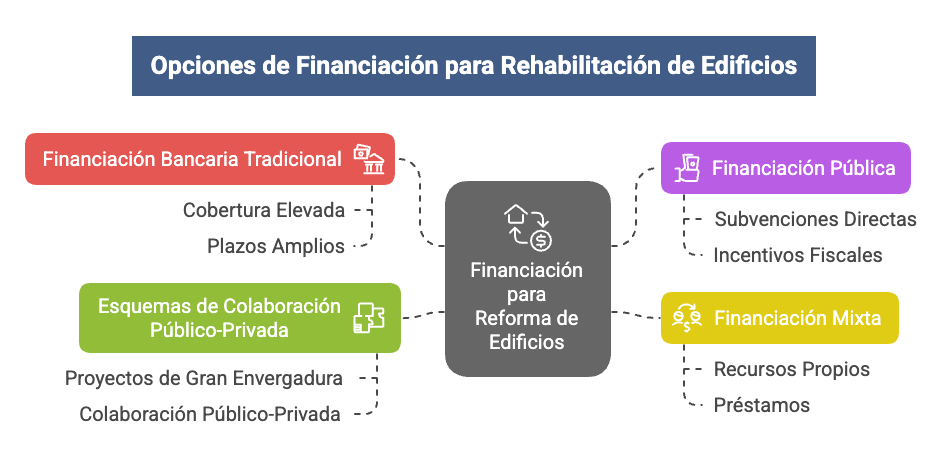
Several approaches are available for funding rehabilitation projects, each with distinct characteristics suited to different needs:
- Traditional bank financing: Dedicated renovation loans with conditions tailored to this type of project.
- Public financing: State, regional, and municipal grant and aid programmes.
- Mixed financing: A combination of equity, loans, and grants.
- Public-private partnership structures: Particularly relevant for large-scale projects.
Property Rehabilitation Loans
Property rehabilitation loans offer terms specifically suited to this type of project:
- High coverage: Up to 80% of the renovation cost can be financed.
- Long repayment periods: Terms of up to 15–20 years make projects more financially viable.
- Streamlined processing: Simplified procedures allow for quicker decisions.
- Reduced documentation burden: Minimising the administrative load on the applicant.
For those working on property flipping projects, our article on how to mitigate risk in property flipping operations offers strategies that apply equally well to rehabilitation projects.
Energy Rehabilitation Financing
Energy rehabilitation financing focuses specifically on works that improve a property's energy performance:
- Direct grants: Between €6,300 and €18,800 per dwelling, depending on the energy savings achieved.
- Subsidised loans: Preferential terms for projects that reduce energy consumption.
- Tax incentives: Deductions for investments in energy efficiency.
- Stackable support: Different instruments can be combined to maximise total funding.
Grants and Financing for Building Rehabilitation
Grants and financing for building rehabilitation draw on a range of public support mechanisms:
- Personal income tax deductions: For works that improve energy efficiency.
- Direct grants: Available to residents' associations and individuals carrying out rehabilitation works.
- Local tax rebates: Including IBI or ICIO reductions, depending on the municipality.
- Comprehensive rehabilitation programmes: Dedicated funding for whole-neighbourhood or area-wide interventions.
Construction Financing for Developers
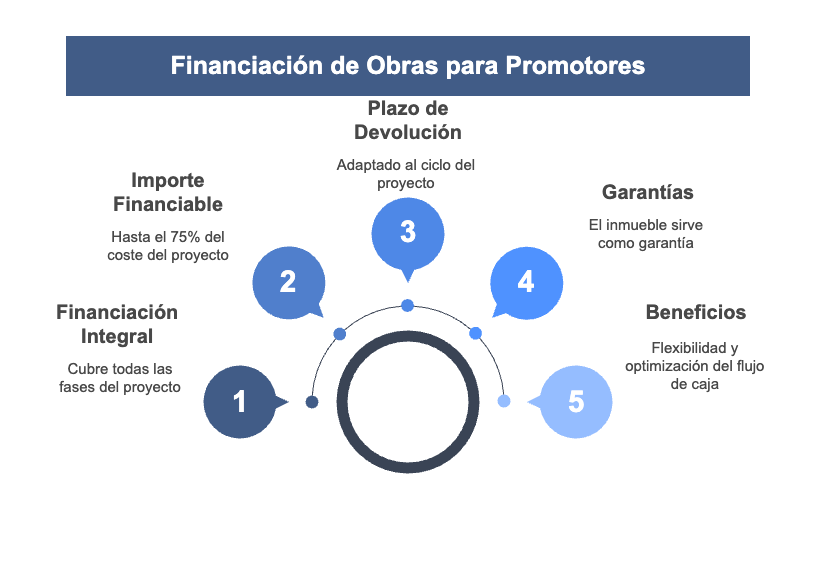
Construction financing for developers targets larger-scale projects:
- ICO guarantee line: Broadening access to bank financing for residents' associations and companies.
- Dedicated financing for major projects: With terms designed for complex real estate developments.
- Structured financing arrangements: Combining multiple financial instruments.
- Project-specific evaluation criteria: Including technical viability, prior track record, and equity contribution.
If you are looking for dedicated loans for developers, GrupInversor offers a specialist line for real estate developments.
Process for Obtaining Financing
Viability Analysis and Budget Preparation
The first critical step is a thorough analysis of the project's viability:
- Preliminary technical study: An assessment of the property's current condition and the scope of work required.
- Market analysis: An evaluation of the renovation's impact on property value.
- Demand study: Particularly important for company-led projects.
- Detailed cost estimate: Covering every element of the works.
- Return on investment analysis: Calculating the payback period and projected returns.
As with property flipping, the strategic selection of improvements is key. Our article on 7 renovations that maximise ROI in property flipping offers useful insights into which interventions deliver the greatest value.
The budget must be comprehensive and detailed, covering:
- Materials
- Labour
- Professional fees
- Licences and permits
- Taxes and duties
- Contingencies
Required Documentation
A typical application for building renovation financing will require:
- Technical project: Signed by a qualified architect or building technician.
- Energy certificates: For both the current state of the property and the projected post-renovation performance.
- Title deeds: Proof of ownership.
- Community agreements: For residential buildings under a horizontal property regime.
- Detailed quotes: From the contractors who will carry out the works.
- Licences and permits: Granted by the relevant authority.
- Economic viability study: Especially for large-scale projects.
Selection of Financial Institutions
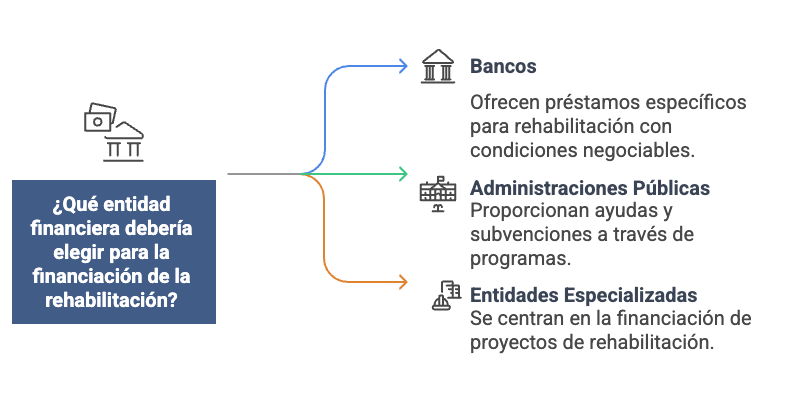
The options for securing financing are varied:
- Banks and financial institutions: Offering dedicated rehabilitation loans.
- Public authorities: Channelling grants and aid through a range of programmes.
- Specialist lenders: Some firms focus exclusively on financing rehabilitation projects.
It is worth comparing several options and negotiating favourable terms, including a clear drawdown schedule that aligns with the phases of the works.
Looking for financing for the renovation of your building or property? Contact us with no obligation. Our team will respond within 24 hours to assess the options available for your situation.
Key Requirements and Considerations
General Requirements
Accessing building renovation financing — particularly public grants — typically involves meeting the following conditions:
- Improvement in energy efficiency: A demonstrable reduction in energy consumption.
- Minimum building age: Generally over 20 years for certain types of aid.
- Energy certification: Required both before and after the works.
- Regulatory compliance: Adherence to current construction and urban planning legislation.
- Equity contribution: Many programmes require a percentage of the project to be funded by the applicant.
The specific requirements vary by grant programme or lender, but improved energy efficiency and compliance with applicable technical standards are almost universally required.
Considerations for a Strong Application
To maximise the chances of securing financing:
- Complete, high-quality documentation: Present all required information with as much detail as possible.
- Rigorous technical project: Prepared by professionals with experience in rehabilitation works.
- Clear demonstration of benefits: Particularly regarding energy savings and improved occupant comfort.
- Demonstrable financial strength: The capacity to cover the unfunded portion and any contingencies.
- Strict adherence to deadlines: Both when submitting applications and during project execution.
A well-prepared application file significantly improves the likelihood of securing financing on favourable terms.
The principles at work here have much in common with the strategies covered in our complete property flipping guide and in our guide to specialist financing for real estate developers.

Conclusion
Building renovation financing represents an outstanding opportunity to improve the quality, efficiency, and profitability of your property or development project. By combining property rehabilitation loans, energy rehabilitation financing, various building rehabilitation grants, and dedicated construction financing for developers, it is possible to carry out ambitious projects with relatively limited equity.
The current environment — shaped by NextGenerationEU funds and the Recovery, Transformation and Resilience Plan — offers unusually favourable conditions for rehabilitation works. However, adequate planning, a clear understanding of the available options, and careful attention to the relevant requirements are all essential.
A well-structured project, backed by rigorous technical analysis, a detailed budget, and an optimised financing strategy, stands a strong chance of success. The right combination of funding sources can make even the most ambitious interventions financially viable.
We encourage you to explore the options relevant to your specific situation and to seek advice from specialist advisers such as GrupInversor who can guide you towards the best financing for your rehabilitation project.
Planning your rehabilitation project or looking for financing for a building renovation? Contact us today for a free initial assessment. Our team will respond within 24 hours with an evaluation of the financing options available for your specific situation.
Frequently Asked Questions (FAQ)
What is meant by "building renovation financing"?
Building renovation financing covers all the financial instruments specifically designed to fund modernisation, updating, or rehabilitation works on properties. Unlike conventional loans, these products are built around the realities of renovation projects, offering special terms, longer repayment periods, and sometimes tax benefits.
What are the basic requirements for a property rehabilitation loan?
The basic requirements typically include:
- Ownership of the property, or authorisation from the owner
- A technical project or descriptive report of the works
- Detailed quotes for the planned works
- Administrative licences and permits
- Demonstrable repayment capacity
- For residents' associations, a community meeting resolution
Specific requirements vary depending on the lender and the nature of the project.
What does energy rehabilitation financing cover?
Energy rehabilitation financing targets works that improve a property's energy performance. It includes direct grants (between €6,300 and €18,800 per dwelling depending on the savings achieved), loans on favourable terms, and tax deductions. Many of these instruments are funded through NextGenerationEU and aim to reduce the energy consumption and CO₂ emissions of existing buildings.
What distinguishes construction financing for developers?
Construction financing for developers is characterised by:
- Greater emphasis on the project's economic and technical viability
- Stricter requirements regarding prior track record and financial strength
- Detailed assessment of the business plan and sales strategy
- Staged financing tied to construction progress
- Access to dedicated facilities such as ICO guarantees
- Greater importance attached to the guarantees provided
- A minimum equity contribution requirement