
Equity Release Spain: Property-Backed Finance Explained (2026)


If you have searched "equity release Spain", there is a good chance you are looking for something that does not exist in the way you know it, and something that does exist, just under a different name. This article starts by making that distinction clearly, then explains what international and non-resident owners of high-value Spanish property can actually access in 2026: private and bank asset-backed financing that lets you unlock capital from an existing property without selling it.
The article covers what UK-style equity release is and why it does not apply in Spain; who is actually searching this term and what they need; how property-backed private financing works in Spain; why Spanish banks often cannot help and what the alternative is; key considerations for non-resident and foreign owners; bridge financing before a sale; how GrupInversor helps you navigate the financing options; and a full FAQ section. Whether you are a first-time enquirer or a property professional exploring options for a client, this is the complete framework.
The financial conditions detailed in this post are indicative only and will vary depending on the lender, the borrower's profile, the specific characteristics of the transaction and prevailing market conditions. Nothing here constitutes a binding offer or guarantee of financing.
Table of Contents
- What equity release means in Spain and what it does not
- Who actually searches equity release Spain and what they need
- How property-backed private financing works in Spain
- Why Spanish banks often cannot help and the alternative
- Non-resident property finance: key considerations for foreign owners
- Bridge financing against a Spanish property before selling
- How GrupInversor helps you access property-backed financing in Spain
- Frequently asked questions
- Conclusion
What equity release means in Spain and what it does not
Equity release, as most UK readers understand it, is a specific regulated financial product: a lifetime mortgage or home reversion plan designed for homeowners aged 55 and over, governed by the Financial Conduct Authority, and operating within the framework of the Equity Release Council.
It allows older homeowners to access a portion of the value of their primary residence while continuing to live in it, with no monthly repayments on a lifetime mortgage: the loan and accrued interest are repaid when the property is sold, typically upon the owner's death or entry into long-term care.
This product does not exist in Spain in any regulated, equivalent form. Spain does not have an Equity Release Council. Spanish law does not have a "lifetime mortgage" as a standardised consumer product. Spanish banks do not offer the product that UK providers market under the equity release umbrella.
What Spain does have is a functioning market for asset-backed private financing: loans secured against the value of an existing property, available to qualifying owners regardless of age, arranged case by case by private capital and specialist lenders. The property stays in the owner's name. The capital is deployed for whatever purpose the owner requires: investment, liquidity, refinancing, bridge-to-sale. The loan is repaid at maturity, typically through sale proceeds, refinancing, or the owner's own capital.
These are structurally different products serving structurally different purposes. The terminological overlap (both involve using property equity to access capital) creates the search ambiguity. This article exists to resolve it.
IN SUMMARY: UK equity release is a regulated, age-restricted lifetime mortgage product. Spanish property-backed financing is an asset-backed private loan available to qualifying owners of Spanish property, case by case, with no age restriction. GrupInversor helps you access the second kind.
Who actually searches equity release Spain and what they need
The search term "equity release Spain" is used by at least three distinct groups, and only one of them will find what they are looking for through a UK lifetime mortgage provider:
British retirees who own a UK property and want to release equity to fund a Spanish purchase. This is a UK equity release transaction on a UK property. A UK-regulated provider handles it. Spain is just the destination of the funds. GrupInversor does not serve this use case; it falls outside our scope.
International owners of existing Spanish property who want to unlock capital without selling. This is the core audience this article is written for. They own a villa in Marbella, an apartment in Ibiza, a finca in Mallorca or a property in Sotogrande, typically valued between €1M and €10M. They need liquidity for an investment, to bridge a timing gap, or to rebalance their financial position. They are not selling. They searched "equity release Spain" because it is the closest English-language descriptor for what they want, even if the product they need is formally described as a préstamo con garantía hipotecaria (asset-backed loan against existing property).

Non-resident buyers or owners seeking a mortgage on Spanish property. Some searches combine equity release intent with non-resident mortgage intent, particularly queries like "spanish mortgage for non residents" or "non resident mortgage spain". These owners may want to finance a purchase, refinance an existing Spanish mortgage, or access capital against a property they already own. All three scenarios are distinct, but all three can be served through the private financing market in Spain.
If you fall into the second or third group, read on. The rest of this article is for you.
How property-backed private financing works in Spain
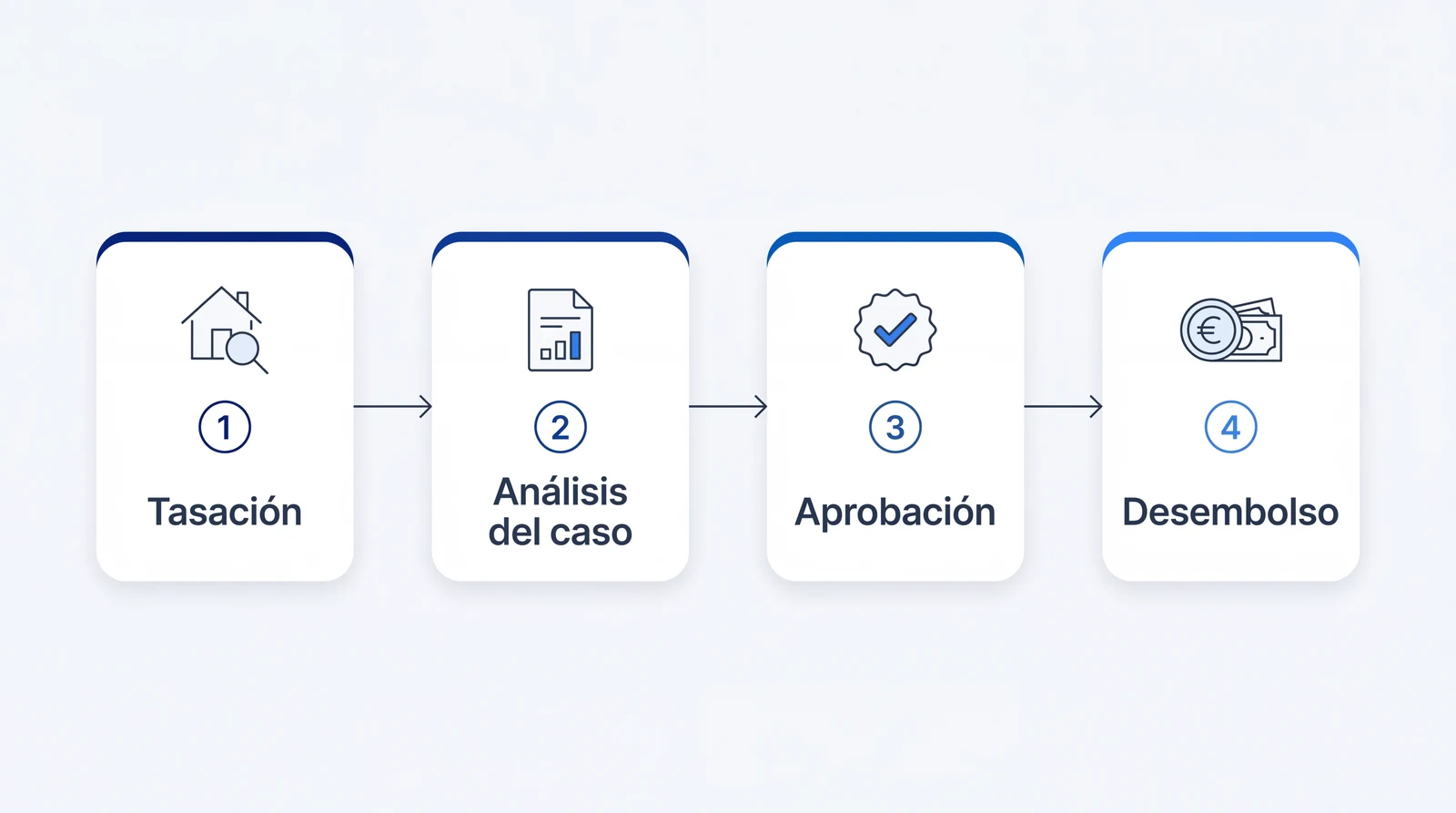
Property-backed financing in Spain means a loan secured by a charge (mortgage/hipoteca) over an existing, titled property, with the capital disbursed to the owner and the property remaining in the owner's name throughout the loan term.
The mechanics in practice:
-
Independent appraisal. The property is valued by an accredited independent appraiser. The appraisal figure is the basis for calculating the Loan-to-Value (LTV) and the maximum financing available.
-
Case analysis. The financing source reviews the asset value, the requested LTV, the property's Land Registry status, the owner's profile, and the exit plan: how and when the loan will be repaid. Private capital evaluates primarily the asset and the exit; income documentation requirements are typically lower than in conventional bank mortgage underwriting.
-
Approval and notarial formalisation. Once approved, the mortgage charge is constituted before a Spanish notary and registered in the Registro de la Propiedad (Spanish Land Registry). This is a legal requirement for the charge to be enforceable.
-
Capital disbursement. The agreed capital is released to the borrower.
-
Repayment at maturity. The loan is repaid at the end of the agreed term, most commonly through the sale of the property, a refinancing to a bank mortgage, or the owner's own liquidity.
Indicative parameters in the private financing market in 2026:
- Loan amounts: €50,000 to €10M
- LTV: typically 40–60% of appraised value, depending on asset type, location, and lien position
- Term: generally 6–36 months; longer terms possible case by case
- Second charges: financing over a property with an existing mortgage is possible in some cases: the lender analyses the residual equity (appraised value minus existing debt) and finances against that surplus
Loan terms, interest rates, and conditions are set case by case. No figure in this article should be read as a guarantee or as a binding indicative offer.
Why Spanish banks often cannot help and the alternative
International owners seeking to unlock capital from existing Spanish property frequently find that Spanish banks are either unwilling or unable to help. This is not a reflection of the asset's quality; it is a structural feature of how Spanish bank mortgage underwriting works.
Spanish banks apply standardised income-based scoring: regular, documented income, Spanish or EU tax residency, active banking relationship with the institution, and conservative LTV thresholds. For an international owner with irregular income, a non-Spanish tax domicile, or a complex ownership structure, these requirements routinely produce a rejection even when the underlying asset is prime and unencumbered.
The comparison below is indicative:
| Criterion | Spanish bank mortgage | Private asset-backed loan |
|---|---|---|
| Approval timeline | 2–6 months (indicative) | Weeks (indicative) |
| Income documentation | Regular documented income required | Lower requirement; asset and exit plan are primary |
| Non-resident owners | Difficult; many banks limit non-resident products | Standard in prime coastal segments |
| LTV (indicative) | Conservative; often below 50% for this segment | 40–60% depending on asset and situation |
| Flexibility of structure | Standardised, limited negotiation | Bespoke: term, drawdown, exit |
| Minimum ticket | Variable; some banks have minimum thresholds | From €50,000 in private capital |
| Cost of capital | Lower | Higher; reflects speed and flexibility |
| Best suited to | Residents with regular income and time | Non-residents, non-standard profiles, time-sensitive operations |
The private capital route is not better than a bank mortgage in absolute terms; it is more expensive. The question is not which is cheaper, but which is available for your specific profile and timeline. An international owner with a prime asset, a non-standard income profile, and a clear exit plan is precisely the case that private capital financing is built for.
For owners who also operate businesses or hold investment structures in Spain, investment loans in Spain and private financing for foreigners in Spain offer complementary perspectives on the broader capital access landscape.
Do you want to know whether your Spanish property qualifies? Tell us about your case. We provide an initial viability assessment, without obligation, typically within 24 hours.
Non-resident property finance: key considerations for foreign owners
Non-resident ownership of Spanish property is widespread, particularly in the prime coastal and island markets. In Marbella, Sotogrande, Ibiza, and Mallorca, international buyers represent a significant proportion of transactions, and a corresponding proportion of owners looking to unlock capital from existing holdings.
Several factors are particularly relevant for non-resident owners considering property-backed financing in Spain:
NIE requirement
Every non-Spanish national who wishes to engage in financial or legal transactions in Spain, including signing a mortgage deed, requires a NIE (Número de Identificación de Extranjero), Spain's foreigner identification number. If you do not have one, obtaining a NIE is a prerequisite and should be factored into the planning timeline.
Land Registry status
For a mortgage charge to be constituted over a Spanish property, the property must be correctly registered in the Registro de la Propiedad and free of any unresolved legal encumbrances. Properties held through certain offshore or complex ownership structures may require additional legal preparation before financing can be formalised.
Tax considerations for non-residents
Taking a loan against a Spanish property does not in itself trigger Spanish income tax. However, any income generated by the property (rental income, for example) may be subject to IRNR (Non-Resident Income Tax), and there may be implications under double taxation treaties depending on your country of residence. Tax advice from a Spanish tax adviser is strongly recommended before proceeding. GrupInversor does not provide tax advice.
Currency and cross-border considerations
Financing is denominated in euros. If your income or assets are held in another currency, exchange rate fluctuation is a relevant factor in structuring the repayment. This is a practical consideration to address at the planning stage, not a disqualifying factor.
The secondary keyword cluster (spanish mortgage for non residents and non resident mortgage spain) captures searches by this exact audience. The product they are looking for is not a standard Spanish consumer mortgage (which is difficult to access for non-residents) but the private asset-backed financing described in this article. Understanding that distinction early saves time and avoids misdirected applications to Spanish retail banks that will decline the case on procedural grounds.
Bridge financing against a Spanish property before selling
One of the most practical applications of property-backed financing in Spain is the bridge-to-sale: accessing capital from a property you intend to sell, but not yet and not at any price.
The logic is straightforward. If you own a villa worth €4M and need €1.5M for another purpose (a new investment, a liquidity need, a business opportunity), you have two options. You can sell the villa quickly, accepting whatever discount a forced timeline implies. Or you can arrange a short-term loan against the villa, access the capital, maintain the property on the market at its correct value, and repay the loan when the sale completes on your terms.
The second option preserves negotiating position on the sale, avoids transaction costs and taxes that would crystallise on an early disposal, and decouples the timing of the capital need from the timing of the property market.
This type of operation differs from bridge loans for property owners in Spain in the context of development financing: here the asset is a finished, titled, market-valued property, not a development project. The analysis is centred on the asset's current value and the owner's credible exit timeline, which typically makes the approval process more straightforward than for construction or development bridge loans.
Practical considerations for a bridge-to-sale operation:
- Exit clarity is critical. Private capital lenders evaluate the plausibility of the exit. If the property is not actively for sale, or if the asking price is significantly above comparable transactions, the lender will factor that into the LTV offered and the term structure.
- Costs at entry and exit. Notarial fees, appraisal costs, and opening commissions are incurred at the start of the loan. Early repayment conditions and any exit fees should be agreed clearly in the loan documentation.
- Term. Short-term bridge operations typically run between 6 and 24 months. If the sale timeline extends beyond the initial term, extension conditions should be agreed at the outset.
How GrupInversor helps you access property-backed financing in Spain
GrupInversor is a financing intermediary: we analyse your case, identify the banking and private capital sources most suited to your asset and profile, and manage the financing process from initial assessment to notarial completion.
We do not lend directly. We work with a network of banking and private capital sources operating in Spain (for properties in Spain) and present your case to the sources with the best probability of approval under the most suitable conditions available.
The process when you work with us:
-
Initial case assessment. You share the basics: property location and estimated value, any existing mortgage, the capital amount you need, intended use, and your preferred timeline. We can provide an initial viability orientation within 24 hours.
-
File preparation. If the initial assessment is positive, we work with you to prepare the dossier: nota simple (Land Registry extract), appraisal if available, ownership documentation, and owner profile. A well-prepared file accelerates approval.
-
Sourcing and presentation. We select the banking or private capital sources that best fit the case profile and present the operation. We manage condition negotiations on your behalf.
-
Completion. We accompany the deal through to notarial signing and capital disbursement.
The financing range we work with in this segment runs from €50,000 to €10M. The most frequent assets are high-value residential and commercial properties in Spain, with a particular concentration in the prime coastal markets of Marbella, Sotogrande, Mallorca, and Ibiza, but we operate Spain-wide.
For the Spanish-language version of this guide, which covers the same product in depth for Spanish-speaking partners or co-investors, see the préstamo con garantía hipotecaria (versión en español).
If your situation involves a business mortgage or a broader investment structure rather than a personal property, business mortgages in Spain may be the more relevant starting point.
To run an initial estimate of the financing you might access, use the loan calculator with your property figures, with no registration or commitment required.
Frequently asked questions
Is equity release available in Spain the same way it is in the UK?
No. UK equity release is a regulated financial product (typically a lifetime mortgage) designed for homeowners aged 55 or over, governed by the Financial Conduct Authority and the Equity Release Council. In Spain, there is no equivalent regulated lifetime mortgage market. What international owners of Spanish property can access is private or bank asset-backed financing: a loan secured against the property, with the owner retaining title, arranged case by case.
Can non-residents release equity from a Spanish property?
Yes. Private capital financing in Spain can be arranged for property owners regardless of their country of tax residence. The property must be correctly registered in the Spanish Land Registry (Registro de la Propiedad) and the owner must hold a valid NIE (foreigner identification number). Non-resident ownership is common in prime coastal markets (Marbella, Sotogrande, Mallorca, Ibiza), and lenders operating in those segments are familiar with the profile.
How much can I borrow against a Spanish property?
Loan amounts depend on the property's independent appraisal value and the LTV the financing source is prepared to extend. As an indicative range, private capital typically works with LTVs of 40–60% of appraised value. On a €3M property, that represents €1.2M–€1.8M. The financing range we work with in this segment runs from €50,000 to €10M. All figures are indicative and subject to individual case assessment.
How long does it take to arrange property-backed financing in Spain?
Private capital moves faster than Spanish banks. An initial viability assessment can typically be obtained within 24–48 hours of submitting the case details. Full approval and notarial completion depends on the complexity of the file, the appraisal process, and Land Registry formalities, but is commonly completed in weeks rather than the months typical of bank mortgage processes. Timescales are indicative and cannot be guaranteed.
Do I need to be a Spanish resident to get a property-backed loan in Spain?
No. Spanish residency is not required. The financing is secured against the property in Spain, not against income or domicile. Non-resident owners holding a NIE and with correctly registered property in Spain can access the same private financing structures as residents, subject to case-by-case analysis. This is one of the key differences between private asset-backed financing and standard Spanish bank mortgages, which often require stronger local banking ties.
What is the difference between a Spanish mortgage and a property-backed private loan?
A Spanish bank mortgage (hipoteca) is a regulated, long-term consumer product designed for property purchase, typically with 20–30 year terms, income verification requirements, and standardised underwriting. A property-backed private loan is shorter-term, arranged case by case, and evaluated primarily on the asset's value and the owner's exit plan rather than income documentation. Private financing is faster and more flexible, but carries a higher cost of capital.
Can I use property-backed financing in Spain as a bridge loan while waiting to sell?
Yes, this is one of the most common use cases. An owner who needs liquidity but does not want to sell at the wrong moment, or needs capital before the sale completes, can arrange a short-term asset-backed loan, access the funds, and repay from the sale proceeds. This differs from developer bridge financing: the asset is already built, titled, and market-valued, which typically simplifies the analysis and shortens the approval timeline.
What areas of Spain does private property-backed financing cover?
Financing can be arranged for qualifying properties across Spain. The highest concentration of deals in the prime private capital market falls in Marbella, Sotogrande, Ibiza, and Mallorca, where international ownership is concentrated and property values support the required LTV thresholds. Prime urban assets in Barcelona and Madrid are also viable. GrupInversor works Spain-wide, not limited to any single region.
Conclusion
The term "equity release Spain" describes a genuine need (unlocking capital from an existing Spanish property without selling), even though the regulated UK product it calls to mind does not exist in Spain. In 2026, the Spanish private financing market offers real solutions for international owners of high-value property: asset-backed loans arranged case by case, with no residency requirement, no age restriction, and no dependency on conventional income documentation.
The key is matching the right financing structure to the specific situation. For an owner with a clear exit timeline (a sale in view, a refinancing planned, or a predictable liquidity event), private asset-backed financing can provide the bridge. For an owner with time, strong Spanish banking relationships, and regular documented income, a conventional bank product may still offer a more economical route. The two are not mutually exclusive: we regularly help clients move from a private capital structure to a bank mortgage as their profile stabilises.
If you own a qualifying property in Spain, residential or commercial, in any region, the first step is a case assessment: asset location and value, current encumbrances, capital required, and intended use. With those inputs, we can identify the financing sources most likely to deliver and structure the approach. You can start that conversation through the loan calculator or, for higher-ticket or more complex situations, by reaching out directly through the contact page.
Do you own high-value property in Spain and want to explore the financing available? Tell us about your case. We analyse the viability and respond within 24 hours with an assessment tailored to your specific situation.