
Property Flipping in Spain 2026: Step-by-Step Guide, 15-30% Returns


Property Flipping: Complete Guide to Invest and Profit in 2026
Introduction to Property Flipping
Property flipping has established itself as one of the most dynamic and profitable investment strategies in the Spanish market. The model — acquiring properties below market value, renovating them strategically, and selling them quickly for a gain — is attracting a growing number of investors looking for short-term returns.
In a market where price fluctuations and a steady supply of undervalued properties create genuine opportunities, property flipping stands out as a compelling alternative to traditional long-term real estate strategies.
This article covers all the essential aspects of property flipping in Spain: from the fundamentals and the step-by-step process, to financing strategies, legal considerations, common risks, and the keys to success. We also look at the best areas for flipping projects in 2026, how to find investors, and which renovations actually add value.
Whether you are a seasoned investor looking to sharpen your approach or you are thinking about your first buy-renovate-sell project, this guide gives you the tools to make informed decisions and maximise your returns.
IMPORTANT NOTICE: The content of this article is for informational purposes only. The information provided does not constitute financial, legal, tax, or investment advice. The strategies, data, and figures on returns mentioned are estimates based on general market conditions and may vary significantly depending on the particular circumstances of each investor, property, location, and economic environment. The author and publisher of this content assume no responsibility for decisions that readers may make based on this information.
Looking for financing for your next property flipping project? GrupInversor offers specialist financing for buy-renovate-sell operations: up to 60–70% of value, approval in 7–15 days, and terms matched to the 6–9 month project cycle. Explore our property flipping financing →
Table of Contents
- Introduction to Property Flipping
- Key Points on Property Flipping
- What is Property Flipping? Concept and Fundamentals
- Financing Options for Flipping Projects
- Risks of Property Flipping and Mitigation Strategies
- The Most Common Mistakes in Property Flipping
- Conclusion: Is Property Flipping Right for You?
- Frequently Asked Questions on Property Flipping
Key Points on Property Flipping
-
Attractive but selective returns: Property flipping in Spain offers potential returns of 15–30% over cycles of 6–9 months. These are significantly higher than traditional rental yields (4–6%), but require careful property and market selection.
-
Alternative financing on the rise: Beyond traditional banks, specialist options — including bridge loans, private financing, and real estate crowdfunding — have emerged, financing up to 60–70% of the purchase or appraised value with approvals in 7–15 days.
-
Emerging areas with high potential: The best opportunities are concentrated in specific neighbourhoods of major cities (Madrid, Barcelona, Marbella, the Balearic Islands, Málaga, Valencia, and others), mid-sized cities with strong demand, and "zoom towns" drawing remote workers.
-
Disciplined risk management is essential: Sustainable success depends on anticipating cost overruns (common in the vast majority of projects), maintaining a financial reserve of around 20% of the total budget, and having fallback exit strategies.
-
Avoidable critical errors: The most damaging and common mistakes are overpaying for the initial property, over-renovating for the target market, and poor contractor management — which causes costly delays to both the renovation and the eventual sale.
-
Growing professionalisation: The Spanish flipping market is moving towards greater geographic and typological specialisation, with investors who focus on specific areas and property types achieving the strongest returns.
-
Adapting to the Spanish context: Unlike the US model, flipping in Spain demands particular attention to managing municipal licences, avoiding illegal occupation issues, and tax optimisation.
Looking for financing for property flipping? Contact us with no obligation. Our team will respond within 24 hours to assess the options available for your situation.
What is Property Flipping? Concept and Fundamentals
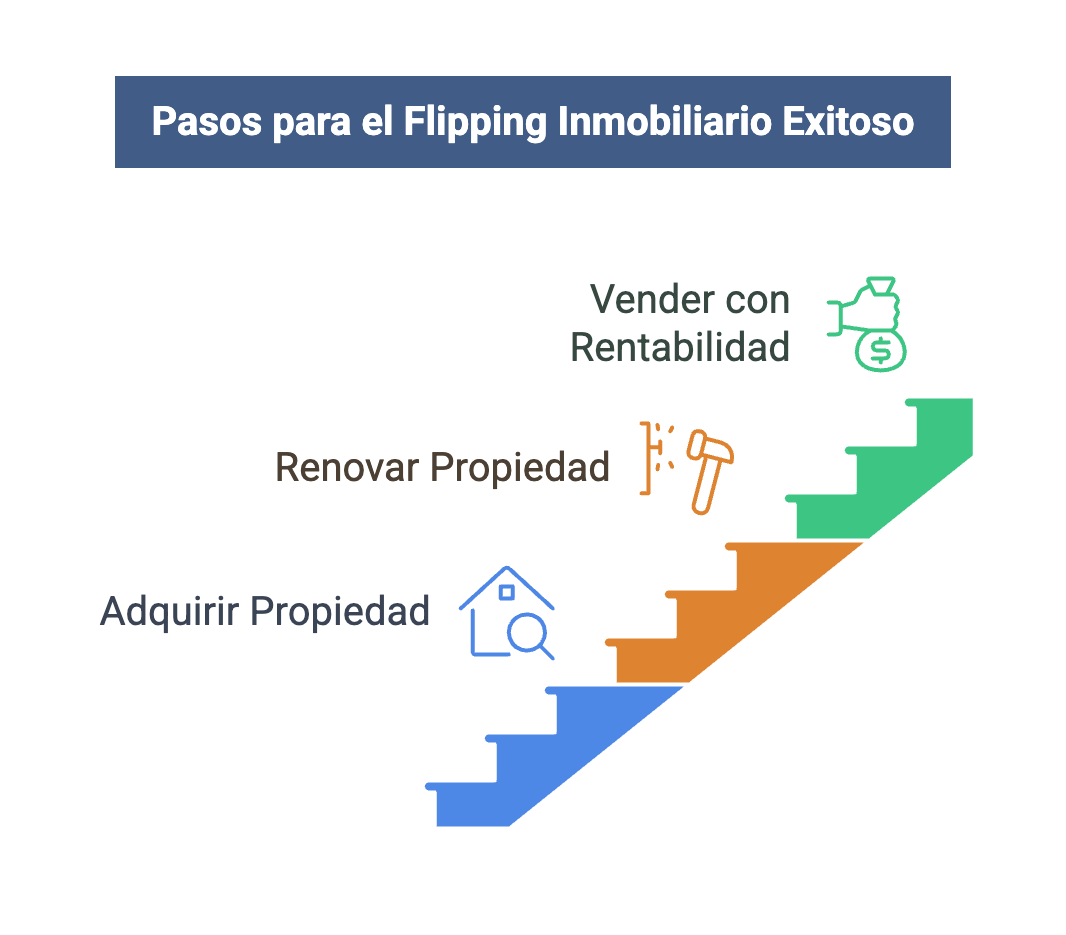
Property flipping is an investment strategy that involves buying a property below market value, carrying out targeted renovations or improvements to increase its worth, and then selling it within a relatively short timeframe to generate a profit. Unlike long-term real estate investment, flipping is built around generating quick gains through the transformation and resale of properties.
Definition and origin of the term "house flipping"
The term "flipping" comes from the verb "to flip" — meaning to turn something over or reverse it — a metaphor for the transformation the property undergoes. The strategy gained mainstream popularity in the United States during the 2000s, particularly in the run-up to the 2008 real estate crash. In Spain, it took hold in a significant way after the 2008–2014 crisis, when the market was flooded with undervalued properties.
According to data from the General Council of Notaries, buy-and-sell transactions increased in both 2023 and 2024. This positive trend is partly driven by the growth of house flipping activity in Spain. Average returns on a flipping project in the Spanish market range between 15% and 30%, depending on factors such as location, the property's initial condition, and how well the project is managed.
Differences from other real estate investment strategies
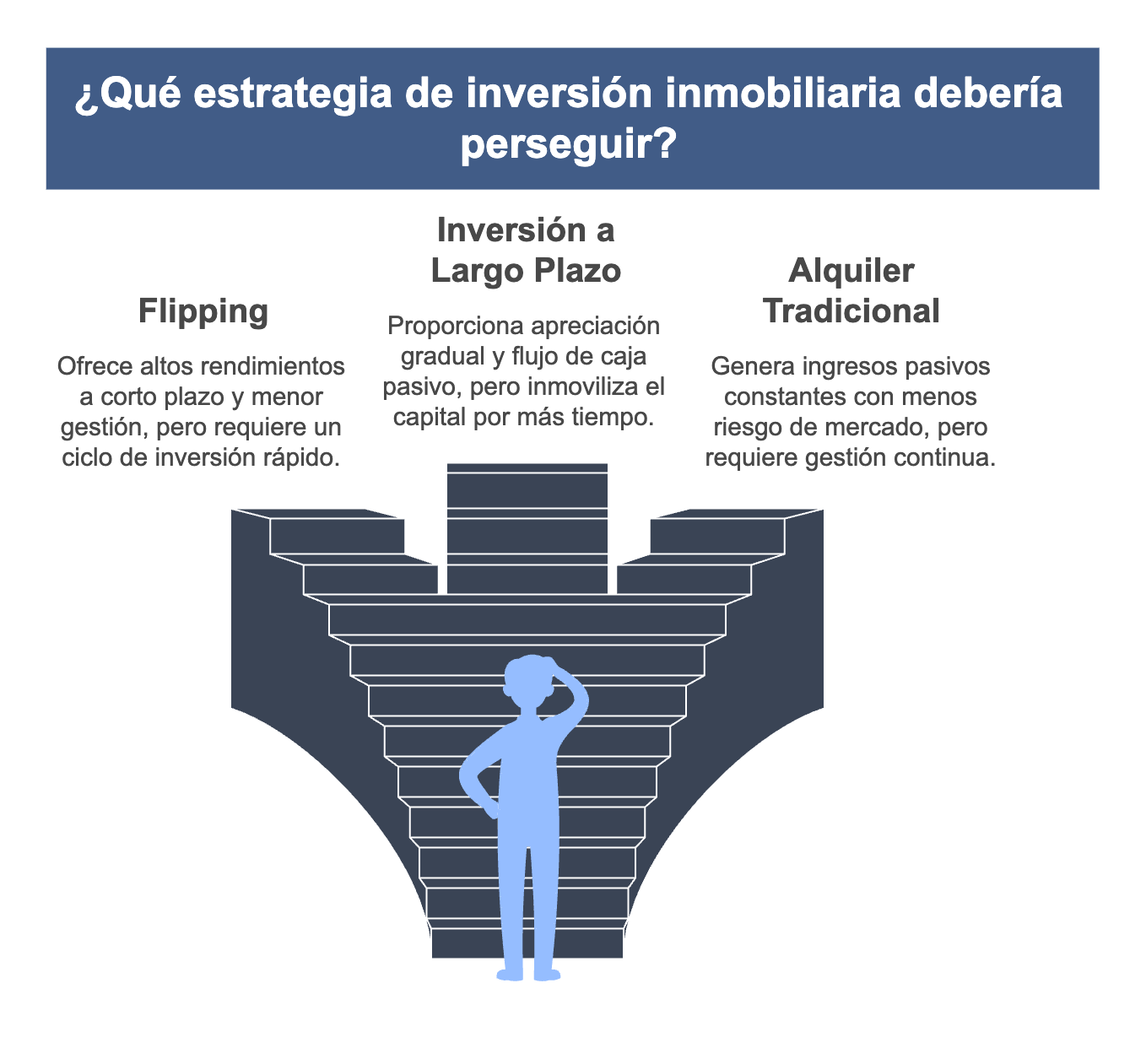
Property flipping has clear distinguishing features when set against other real estate strategies:
Comparison with long-term investment
Traditional long-term investment involves holding a property for years or decades to benefit from gradual capital appreciation and rental income. Flipping, by contrast, runs on short cycles — generally 3 to 12 months. This compressed timeframe offers two key advantages:
- Faster capital recycling: Profits can be reinvested in new projects multiple times a year.
- Lower exposure to long-term market risk: A shorter holding period reduces vulnerability to sustained market downturns.
Buy-and-hold and traditional rental strategies generate steady passive income, but tie up capital for much longer periods.
Advantages over traditional rental
Compared to standard buy-to-let, property flipping offers meaningful advantages for the right investor:
-
Stronger short-term returns: Gross annual rental yields in Spain currently average around 5.5% according to the Bank of Spain's annual report. A well-executed flipping project can deliver 15–30% returns within 6–9 months.
-
No ongoing management burden: There are no tenants to manage, no rent arrears to chase, and no recurring maintenance obligations.
-
Lower exposure to illegal occupation: The short investment cycle substantially reduces the risk of squatting, which 2024 data shows disproportionately affects properties left vacant for extended periods.
One strategy gaining traction in Spain is the BRRRR method (Buy, Rehab, Rent, Refinance, Repeat) — an alternative to pure flipping. Where flipping follows a buy-renovate-sell cycle, BRRRR adds further steps: buy an undervalued property, rehabilitate it, rent it out for cash flow, refinance to recover a large portion of the initial outlay, then repeat the process. Some Spanish investors are adapting this method to local conditions, blending elements of both approaches depending on the market and waiting for the optimal moment to sell.
Financing Options for Flipping Projects
Financing is one of the biggest challenges in property flipping. Having access to the right capital at the right time can mean the difference between seizing an exceptional deal and watching it slip away. Below we examine the financing options for flipping projects available in today's Spanish market, along with their advantages, limitations, and key requirements.
Traditional financing: advantages and limitations
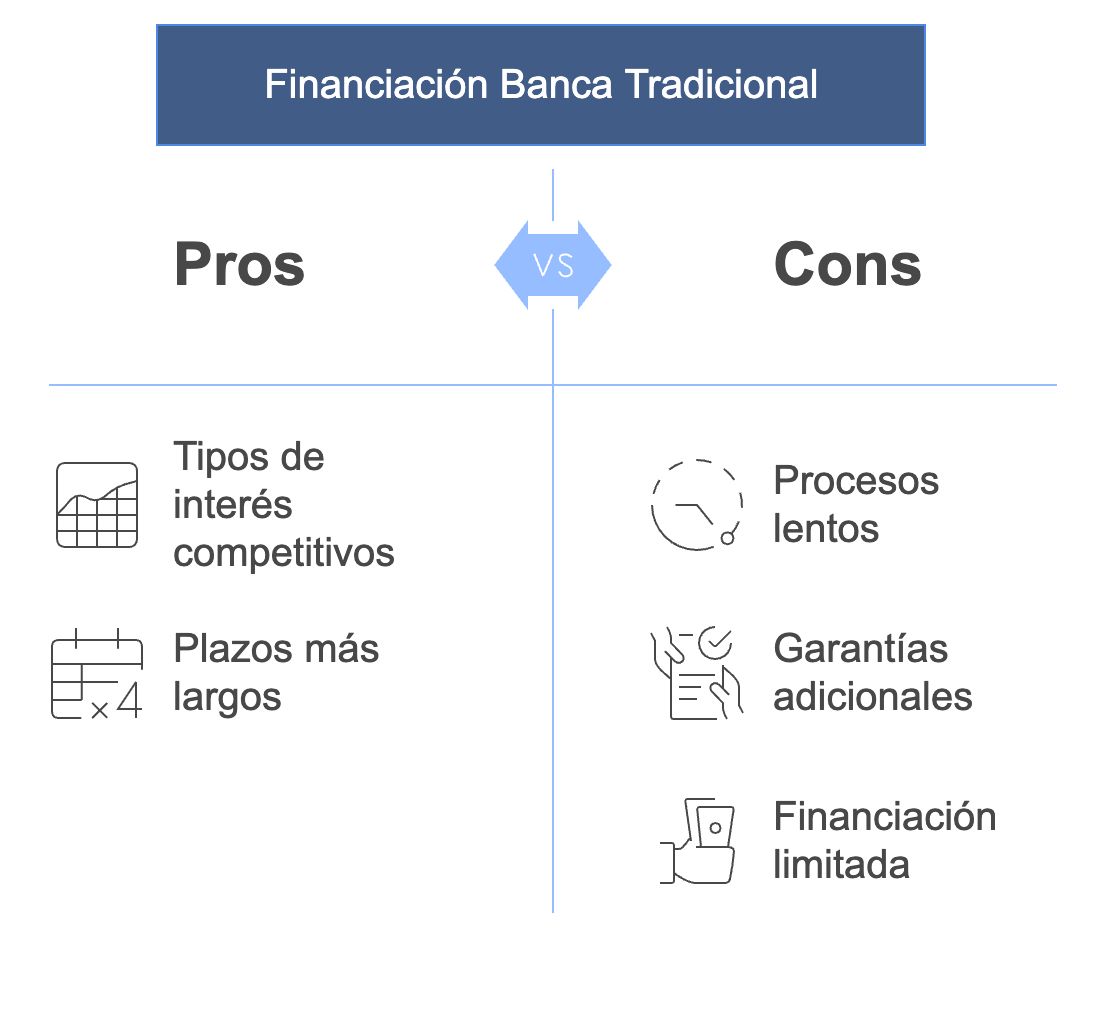
Traditional banks remain a viable option for investors with strong credit histories and adequate security. That said, there are important constraints for flipping projects:
Specific mortgages for developers
Some financial institutions offer products designed for small developers and renovators — including developer mortgages. These typically cover between 50% and 60% of the purchase price, with some lenders offering up to 70% in specific locations.
Advantages:
- More competitive interest rates
- Longer repayment terms available
Limitations:
- Slower approval and completion timelines (60–90 days)
- Additional security requirements
- Limited LTV ratio (rarely exceeding 60%)
Alternative financing: dedicated solutions for flipping
The alternative finance sector in Spain has grown rapidly, producing solutions tailored specifically for property flipping:
Bridge loans
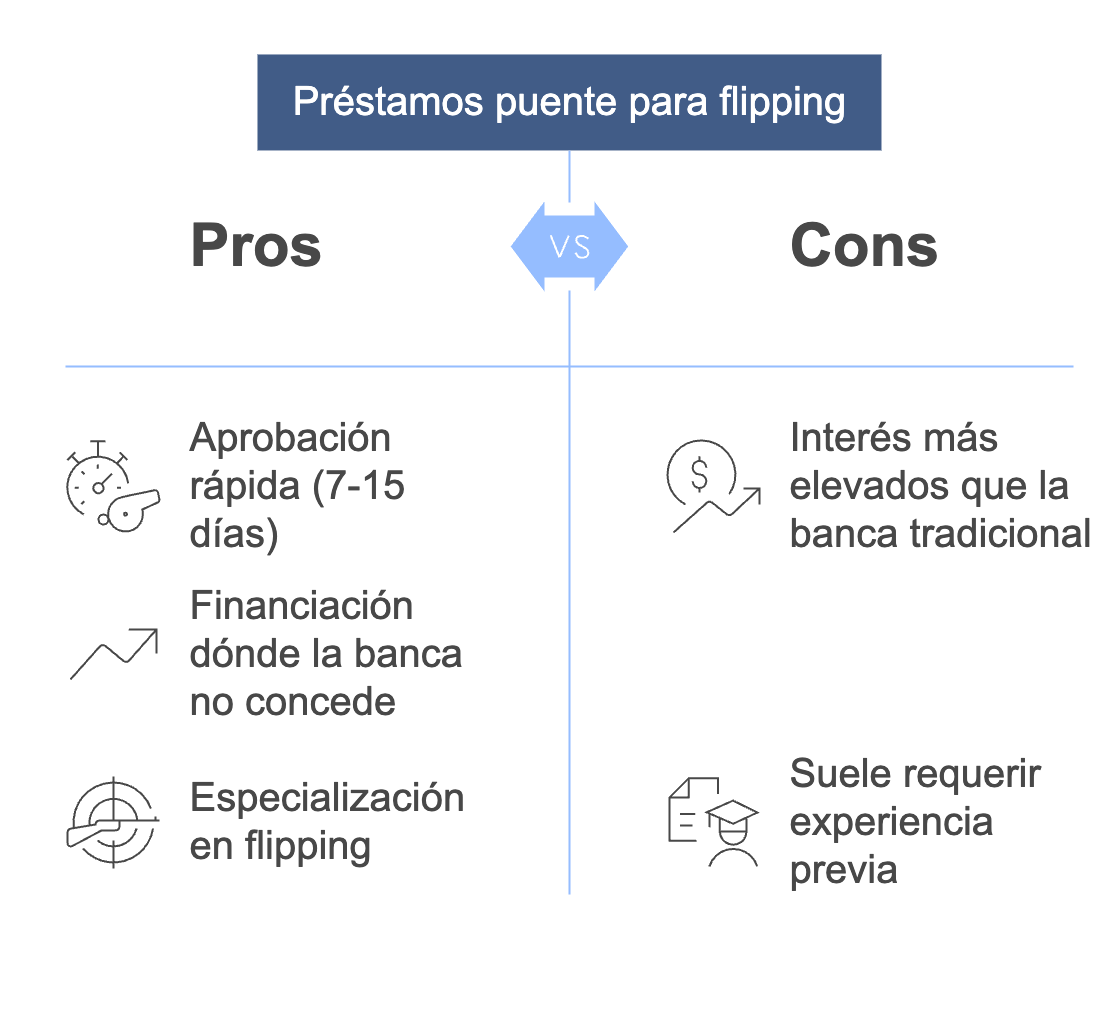
Bridge loans have become a core tool for flipping investors. At GrupInversor we work with partner institutions that can provide fast, short-term financing (6–24 months) specifically for buy-renovate-sell projects.
Advantages:
- Fast approvals (7–15 days)
- Available in situations where traditional banks decline
- Structured around the flipping model
Limitations:
- Slightly higher interest rates than traditional banking
- Prior experience is often required
Real estate crowdfunding
Real estate crowdfunding has grown substantially as a funding source for property flipping.
For a flipping investor, these platforms can finance between 30% and 70% of a project, complementing equity or other funding sources.
Planning your next real estate development or looking for financing for property flipping? Contact us today for a free initial assessment. Our team will respond within 24 hours with an evaluation of the financing options tailored to your specific situation.
Risks of Property Flipping and Mitigation Strategies
Property flipping can deliver attractive returns, but it carries real risks that must be understood and actively managed. Key areas to watch include:
- Cost overruns during the renovation phase
- Hidden structural problems
- Market shifts during the project
- A slowdown in prices or buyer demand
- Illegal occupation
For a deep dive into the main risks and how to manage them, see our article on how to mitigate risk in property flipping operations.
The Most Common Mistakes in Property Flipping
Property flipping can be highly profitable, but it is also an activity where mistakes can seriously erode returns — or even cause outright losses. A significant number of flipping projects fall short of their target returns because of errors that are entirely avoidable. Here we examine the most frequent mistakes made by both first-time and experienced investors, and how to sidestep them.
Errors in the selection and purchase phase
The acquisition phase is critical. Mistakes made here are almost impossible to recover from later.
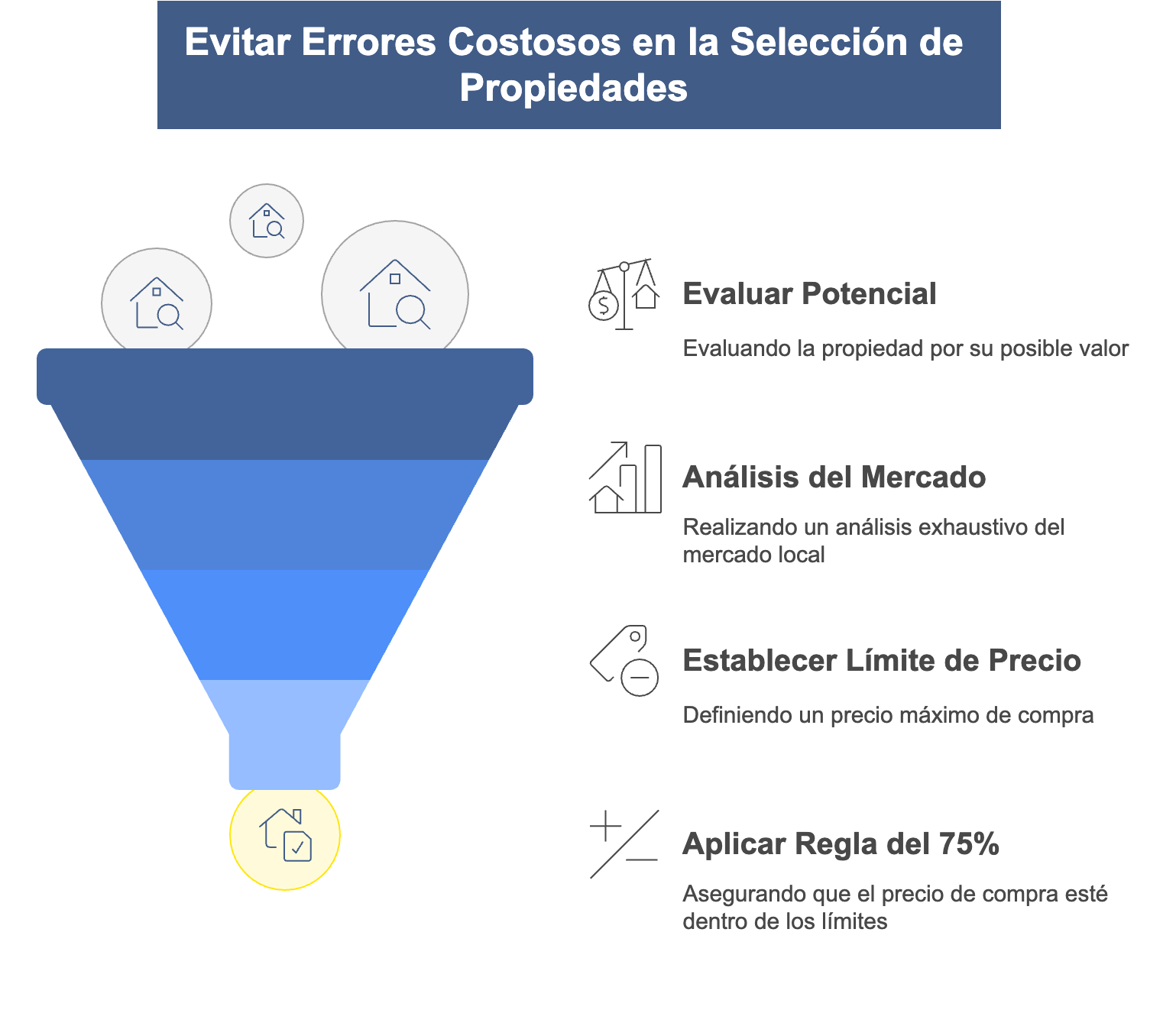
Overpaying for the initial property
The single most costly mistake in property flipping is overpaying at the outset. It sounds obvious, yet a surprisingly large number of loss-making projects can be traced back to an inflated purchase price. From day one, regardless of the renovations carried out, the project was never going to be profitable.
Common causes:
- Excessive enthusiasm for a property "with potential"
- Superficial analysis of the local market
- Competitive pressure in fast-moving markets
- Overestimating how much renovations will add to the final sale price
How to avoid it:
- Rigorously applying the "75% rule" — paying no more than 75% of the estimated post-renovation value, minus renovation costs and expenses
- Running thorough comparable analysis against at least 10–15 similar properties sold recently
- Setting a maximum purchase price before entering negotiations and sticking to it
- Stress-testing profitability projections with pessimistic scenarios
Failures in planning and executing renovations
Once the property has been acquired, the renovation phase brings its own pitfalls that can significantly eat into margins.
Over-renovating for the target market
A surprisingly common mistake is renovating to a standard of quality or specification that the target market simply will not pay for.
In our experience, many flipping developers install features that fail to generate a proportional return on their cost. For more on maximising returns through smart renovation decisions, see our post on 7 Renovations that Maximise ROI in Property Flipping.
Conclusion: Is Property Flipping Right for You?
Property flipping is a strategy with real potential in today's Spanish market, capable of delivering returns of 15–30% within relatively short cycles. Throughout this article we have covered its fundamentals, financing options, inherent risks, and the most common errors to avoid.
This is not an activity to approach casually, nor a shortcut to easy money. Success in property flipping demands specialist knowledge, meticulous planning, disciplined execution, and the ability to adapt. The investors who stand out consistently combine analytical rigour with creativity, financial discipline, and a reliable network of professionals.
If you are thinking about taking your first steps in this short-term real estate investment strategy, we recommend starting with a modest project in a market you know well, with experienced professionals alongside you. Geographic and typological focus consistently produces better results than spreading across multiple areas.
Whether you are an experienced investor looking to diversify, or an entrepreneur drawn to this business model, property flipping can be an excellent fit — provided you approach it with the right preparation.
Ready to launch your first flipping project? Assess your resources, build a detailed plan, assemble the right team, and take the first step towards what could become a genuinely profitable investment activity.
Planning your next real estate development or looking for financing for property flipping? Contact us today for a free initial assessment. Our team will respond within 24 hours with an evaluation of the financing options tailored to your specific situation.
Frequently Asked Questions on Property Flipping
How much capital do I need to start house flipping in Spain?
To start a property flipping project in Spain, expect to need between €120,000 and €180,000 in secondary cities, and upwards of €250,000 in Madrid or Barcelona. This budget must cover acquisition, renovation, administrative costs, and financing charges. Having at least 30–35% of equity is recommended, with the remainder sourced through financing. To reduce risk on a first project, consider partnering with experienced investors or starting with a smaller property that requires a lower initial outlay.
How can a property flipping project be financed?
Financing options for flipping projects include mortgages and developer loans (covering up to 70% of appraised value), specialist bridge loans, private investors, seller financing via earnest money contracts with extended terms, and real estate crowdfunding platforms. The current trend favours hybrid structures combining 30–40% equity with specialist alternative financing at short terms and fast approval times (7–15 days). At GrupInversor we can help you secure the financing you need regardless of the product or deal structure.
What are the common mistakes in property flipping to avoid?
The most damaging property flipping mistakes include overpaying for the initial property, underestimating the extent of structural issues (leading to budget overruns), over-renovating for the target market, poor contractor management, mispricing at the sales stage, and overlooking the tax implications. The key to avoiding them lies in thorough due diligence, applying the "75% rule" on acquisition, and running professional project management.
Is property flipping profitable compared to other investments?
Property flipping in Spain offers potential returns of 15–30% over cycles of 6–9 months — significantly higher than traditional rental yields (4–6% annually) and many financial instruments. It does, however, demand greater commitment, specialist knowledge, and active risk management. Its main edge over other real estate strategies is rapid capital recycling and lower exposure to long-term market risk. Investors who specialise in specific areas and property types consistently outperform those who spread across multiple markets, giving professionally executed property flipping a genuine competitive advantage.